
Content-Aligned Visibility
Reach audiences through native placements that align with the surrounding content experience, topic environment, and user context.
Programmatic native advertising built for content-aligned visibility, audience relevance, and measurable media performance.
Sirius Ads helps organizations use native advertising as a strategic media channel within a larger programmatic media system. Through audience intelligence, premium native inventory access, content-aligned placement strategy, and Pulse by Sirius reporting, native campaigns can support awareness, consideration, retargeting, and omnichannel campaign performance.
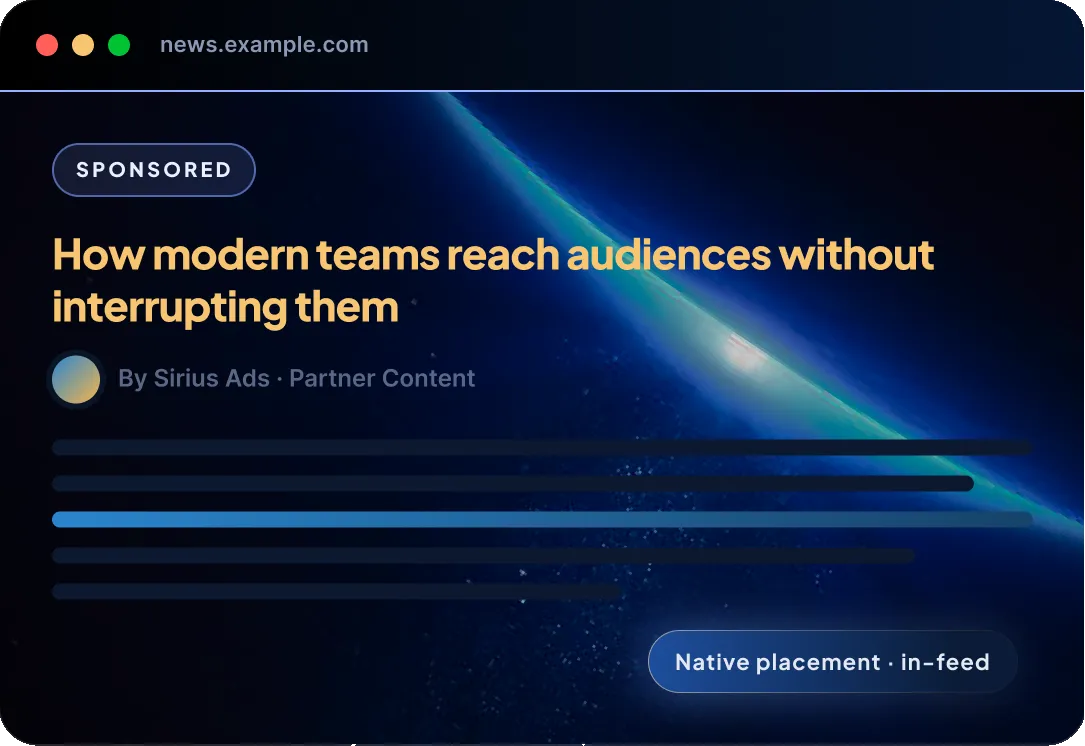
Native advertising gives organizations a way to reach audiences through ad placements that align more naturally with the surrounding digital content experience.
Rather than relying on banner-style visibility alone, native ads are designed to fit the look, feel, and context of the page, feed, article, or recommendation environment where they appear. This makes native advertising valuable for campaigns that need a softer entry point, stronger contextual relevance, and consideration-stage engagement.
Sirius Ads uses programmatic native advertising to help organizations place relevant messages in front of defined audiences across premium native media environments.
Reach audiences through native placements that align with the surrounding content experience, topic environment, and user context.
Use native advertising to support users who are researching, comparing, evaluating, or moving toward a decision.
Present campaign messaging through formats that feel more integrated with the digital content environment.
Connect native advertising with display, mobile, video, audio, Connected TV, GeoFencing, DOOH, email, social mirroring, and retargeting channels to reinforce campaign impact.
Native advertising can serve multiple roles within a larger media strategy.
| Campaign Goal | How Native Advertising Supports It |
|---|---|
| Brand Awareness | Builds visibility through content-aligned digital placements |
| Consideration | Supports softer, more contextual messaging for audiences evaluating options |
| Sponsored Content-Style Visibility | Places campaign messages in formats that feel integrated with digital content |
| Audience Engagement | Reaches users in environments where they are already consuming relevant content |
| Landing Page Traffic | Encourages deeper exploration through contextually aligned campaign messaging |
| Retargeting Support | Re-engages audiences after website, landing page, or campaign interaction |
| Local Market Visibility | Reaches audiences in specific cities, regions, or service areas |
| Omnichannel Reinforcement | Extends campaign messaging across display, mobile, video, audio, CTV, GeoFencing, DOOH, email, and social mirroring |
Native advertising is especially valuable when an organization needs content-aligned visibility without relying only on banner-style placements or more interruptive media formats.
Common use cases include:
Native becomes stronger when it is connected to a larger programmatic strategy. Sirius Ads uses native as part of a broader system designed to improve audience relevance, support consideration, and provide clearer performance visibility.
Sirius Ads approaches native advertising as a strategic media channel, not as a content marketing service or generic sponsored article placement.
Through Pulse by Sirius, native campaigns can be planned, activated, monitored, and measured with stronger alignment across audience targeting, premium native inventory access, placement context, reporting, and attribution.
Sirius Ads can help organizations:
The result is a more accountable native advertising strategy built around content relevance, audience intelligence, and performance visibility.
Programmatic native advertising allows organizations to reach defined audiences through data-informed media buying across native ad environments.
This helps campaigns move beyond one-off sponsored placements and into a more strategic model built around audience quality, contextual relevance, premium inventory access, budget control, and reporting visibility.
Content-aligned advertising helps organizations place campaign messaging in environments where users are already engaging with relevant topics, categories, or digital content.
This can support stronger message fit, softer introduction, and more natural campaign engagement across the open web.
Sponsored content-style placements can help campaign messages appear in formats that feel more integrated with the surrounding page, article, feed, or recommendation environment.
This is useful when the campaign needs to introduce an idea, service, offer, or value proposition in a way that feels less disruptive than traditional ad formats.
Native retargeting helps organizations reconnect with users who have visited a website, viewed a landing page, engaged with content, or interacted with a campaign.
This can support longer buying cycles, high-consideration services, B2B campaigns, healthcare, senior living, legal, higher education, and other categories where users may need multiple touchpoints before taking action.
Native advertising can support consideration-stage messaging by giving organizations a more contextual way to introduce value, reinforce credibility, and guide users toward deeper engagement.
This makes native useful for campaigns that need to build trust, explain an offering, or move audiences from awareness into evaluation.
Effective native advertising depends on audience relevance, placement context, and message alignment.
Sirius Ads can shape native campaigns around audience behavior, geography, interests, content environment, previous engagement, and campaign objectives.
Targeting options may include:
This allows native campaigns to support more intentional media delivery across the customer journey.
Native advertising can be especially effective when a campaign needs to do more than generate quick visibility.
A user may be researching a service, comparing options, reading related content, or browsing a topic connected to the campaign. Native placements can help introduce the brand in a more contextual environment and support deeper movement toward consideration.
Sirius Ads can use native advertising to support:
For organizations with complex offerings or longer buying cycles, native can add a valuable consideration layer to the media mix.
Native advertising and display advertising can work together, but they should not be treated as the same channel.
Display advertising typically uses visual ad units across websites, apps, and digital environments. Native advertising focuses on placements that align more closely with the surrounding content experience.
Sirius Ads keeps these roles distinct:
This separation helps native own the content-aligned media role inside the broader programmatic ecosystem.
Native advertising is not the same as content marketing.
Content marketing usually involves creating owned articles, blogs, resources, guides, or organic educational content for a brand’s website or distribution channels.
Native advertising is a paid media channel. It focuses on placing campaign messaging through native ad inventory, sponsored content-style placements, and content-aligned media environments.
Sirius Ads can use native advertising to support:
This keeps native advertising aligned with Sirius Ads’ media-buying ecosystem rather than turning it into a blog, SEO, or content production service.
Native advertising should provide more than placement delivery alone.
With Pulse by Sirius Reporting, organizations can gain clearer insight into campaign delivery, audience engagement, placement performance, geographic trends, retargeting activity, and attribution-related signals.
Reporting may include:
The goal is not simply to show that native placements ran. The goal is to understand how native advertising contributes to the larger media strategy.
Native advertising is valuable for industries that need content-aligned visibility, audience engagement, and stronger consideration-stage support.
Each campaign can be shaped around audience behavior, geography, market conditions, seasonality, competitive pressure, message complexity, and conversion goals.
Native advertising becomes stronger when it works as part of a connected media strategy.
A user may encounter a native placement while reading content, later see a display ad, hear a streaming audio message, watch a Connected TV ad, pass through a GeoFenced location, view a video placement, or engage with a mobile ad. Each touchpoint can reinforce the campaign message and support movement through the customer journey.
This makes native a valuable content-aligned channel inside an omnichannel programmatic strategy.
Native can support:
Sirius Ads brings native advertising into a larger media-buying ecosystem built around audience intelligence, premium native inventory access, strategic execution, and performance visibility.
Native campaigns are supported by Pulse by Sirius, connecting audience targeting, activation, reporting, and optimization inside a more accountable media-buying framework.
Campaigns are shaped around the audiences, markets, behaviors, content environments, and message contexts that matter most to the organization’s goals.
Native campaigns can be activated across quality native media environments with stronger alignment between placement strategy and campaign objectives.
Pulse by Sirius reporting helps organizations see how native contributes to campaign delivery, engagement, retargeting activity, and broader media performance.
Native advertising is planned as part of a larger growth system, not as an isolated sponsored placement.
Native advertising is a paid media strategy that places ads in formats designed to align with the surrounding content experience. Sirius Ads uses native advertising to help organizations reach defined audiences through content-aligned placements with stronger targeting and reporting visibility.
Programmatic native advertising uses data-informed media buying to activate native ad placements across digital environments. Campaigns can be shaped around audience targeting, geography, behavior, content context, and campaign goals.
No. Display advertising usually uses visual ad units such as banners or responsive placements. Native advertising is designed to align more closely with the surrounding content, feed, page, or recommendation environment.
No. Content marketing usually involves creating owned articles, blogs, guides, or organic resources. Native advertising is paid media delivered through native ad inventory or sponsored content-style placements.
Native ads can support brand awareness, consideration-stage engagement, service promotion, landing page traffic, audience retargeting, and omnichannel media reinforcement.
Native advertising can reinforce messages from display, Connected TV, GeoFencing, audio, video, mobile, DOOH, email, social mirroring, and retargeting campaigns. It helps extend campaign visibility into content-aligned digital environments.
Sirius Ads uses native advertising as part of a larger media-buying ecosystem supported by Pulse by Sirius, audience intelligence, premium native inventory access, reporting visibility, and strategic omnichannel execution.
Native advertising gives organizations a way to reach audiences through content-aligned placements that support relevance, engagement, and consideration.
Sirius Ads helps organizations use programmatic native advertising with stronger audience targeting, better reporting visibility, and greater alignment across the media mix.
Through Pulse by Sirius, native campaigns can become part of a smarter, more accountable media-buying system built around audience intelligence, content-aligned strategy, strategic execution, and measurable growth.